


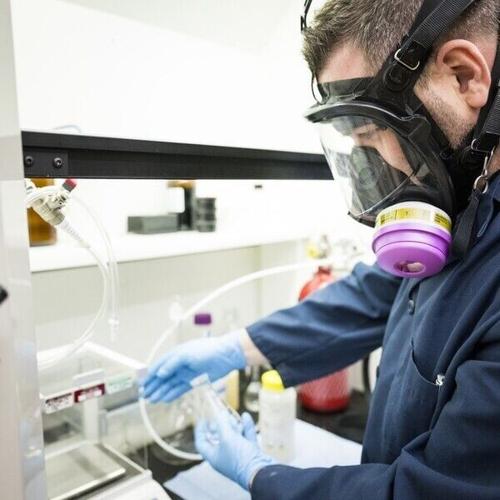
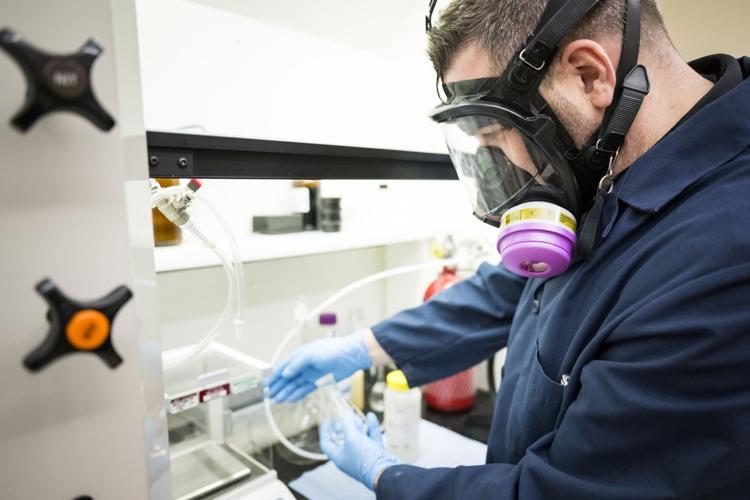
(Photo above taken at Valiscor, a pharma-focused chemical manufacturing company specializing in fluoroalkylation founded by OSU Professor of Chemistry Rich Carter, who was a graduate of the first class of the OSU Advantage Accelerator.)
For the last 13 years, the OSU Advantage Accelerator has been helping some of the university’s most innovative thinkers turn their research into startup businesses. The work has been so successful that recently, TIME named it among the nation’s top 25 incubators and accelerators, and one of the top 10 university-based accelerators.
In October, the program was also named the 2026 recipient of Oregon Entrepreneurs Network’s Tom Holce Community Catalyst Award, which recognizes organizations that strengthen entrepreneurship through connection, education and services.
People are also reading…
Through the work of the Advantage Accelerator, more than 130 companies have been created, and a subset of those companies have received follow-on funding of more than 800 million dollars.
Karl Mundorff, executive director of innovation and entrepreneurship and director of the accelerator at Oregon State, says the key to their success has been meeting entrepreneurs where they are, and focusing on the societal impact as much as potential profitability.
“It’s about the societal impact that a university can play that gives us a different lens than a traditional private accelerator,” Mundorff said. “We can give back to the state and beyond.”
Clients come to an accelerator with a business idea based on their research or developed technology. The accelerator team, and sometimes industry specific mentors, takes clients on a guided process of about two months to validate whether their business idea is actually solving a problem that people have and are willing to spend money on to solve, or if the idea needs to be tweaked or pivoted to truly meet customer needs. The program can be used again after that adjustment process to ensure the tweaks were successful, and that the business has a solid chance of success.
“It’s a much more beneficial use of time and resources,” Mundorff said.
Mundorff is an OSU alum and has a long history working with tech startups, including as director of research programs for Oregon BEST, a State Signature Research Center focused on clean technology, including sustainable and green products and services. In that position, he worked frequently with public research universities. Oregon State ended up being his largest customer because of the amount of cleantech research happening on campus. In 2015, he joined the Advantage Accelerator to begin working more exclusively with the university.
“We’ve been growing and expanding our ecosystem not only for OSU researchers and the impact that their research can have on society, but also to help the community in validating their technologies,” Mundorff said. “We are a land grant university and part of that mission is economic development, and startups are definitely an aspect of economic development.”
OSU is the lead academic institution for FAST (Frontiers of Advanced Semiconductor Technology), which was just selected as an NSF Regional Innovation Engine award recipient, and as part of the award, the Advantage Accelerator will be running a specific semiconductor cohort every winter to attract semiconductor companies as well as faculty researchers from OSU and other northwest universities to the program.
With 60 active Oregon companies that have roots in the Advantage Accelerator, there are plenty of success stories, but for Mundorff, a few really stand out. One is OSU Professor Emeritus Joe Beckman, a biochemist who is one of the world’s top researchers of ALS. Beckman had been struggling with the limitations of examining ALS-related proteins in a mass spectrometer, which only gave him a partial view. He realized he needed to invent a way to view the proteins in 3D to enable researchers to better study them.
Beckman developed a new technology for mass spectrometry and brought it to the accelerator. His company, E-MSion, Inc was born, and his discovery was eventually acquired by Agilent Technologies. Beckman was then able to return to his ALS research and is seed-funding a new ALS startup.
“It’s as important to us,” Mundorff said, “to support technology that has societal impact as it is important for the technology to be profitable.”


