


Nearly 50 researchers and staff from Oregon State University attended this year’s Biennial Conference on the Biology of Marine Mammals, the premier event for scientists studying marine mammals worldwide.
The experience will help prepare the Marine Mammal Institute in OSU’s College of Agricultural Sciences to host the seven-day conference for the first time in Portland in 2028.
The MMI sent 45 of its roughly 60 professors, postdoctoral scholars, graduate students and research staff, while Oregon Veterinary Diagnostic Laboratory Director Kurt Williams attended to present his findings on the humpback whale that was stranded on the Oregon Coast last fall. The event ran Oct. 17-23 in San Juan, Puerto Rico.
As the conference is the best opportunity to hear the latest marine mammal research, network with colleagues and gain valuable feedback on new ideas, MMI Director Lisa Ballance makes it a priority to send as many researchers as possible each time. The institute is renowned in the international marine mammal community.
People are also reading…
“Without a doubt, we are world leaders. I can’t think of an institute focused on marine mammal research that has the breadth, depth and impact that we do,” said Ballance, who is also a founding member and now president-elect of the board of the Society for Marine Mammalogy, which organizes the conference. Since becoming MMI director in 2019, she has grown OSU’s institute from 25 to 60 people.
“We work globally in all oceans of the world; we work on a broad range of taxa, from large whales to small porpoises, from genes to entire ecosystems and everywhere in between,” Ballance said. “It makes it hard to find an area of marine mammal biology that we don’t have expertise in.”
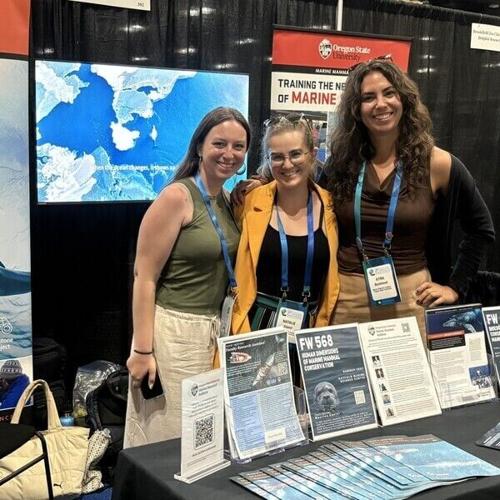
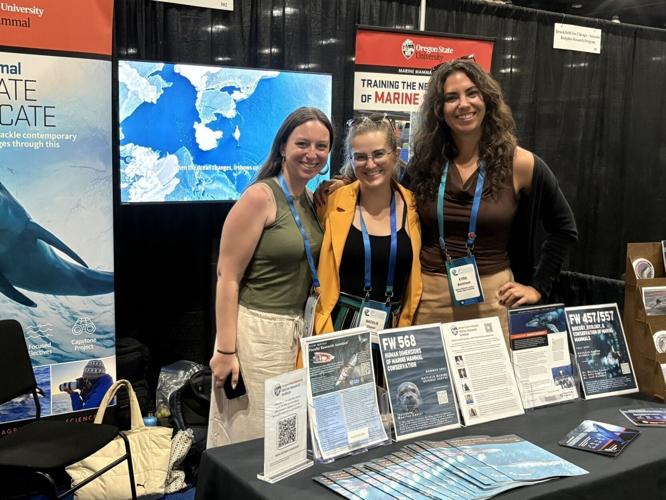
In Puerto Rico, about 25 OSU graduate students gave presentations on their research. MMI researchers co-led daylong workshops on satellite telemetry, the use of tracking devices on animals to collect location and dive data, and on eDNA, detecting DNA from seawater to identify animals in the region. The institute also hosted two booths, one introducing attendees to the MMI as a whole, with information about classes and researchers, and one about the upcoming 2028 conference.
MMI researchers and graduate students presented on a variety of topics, including unusual mortality events among gray whales, passive acoustic studies in the Arctic showing the changing geographic distribution of whale species, cooperation between dolphins and humans, how hormones from teeth can indicate stress associated with human activities, and the use of drones to observe never-before-seen whale behavior in the wild.
“This conference is where people present the newest results and ideas before they’re published. It keeps you on the crest of the wave of innovation and new knowledge,” Ballance said. “Students obtain valuable feedback on their presentations — they learn how to do science, the process whereby you put your ideas out there, get feedback, then further hone them.”
For Williams, a veterinary pathologist and director of the OVDL at OSU’s Gary R. Carlson, MD, College of Veterinary Medicine, this year’s conference was his first time working with the Society for Marine Mammalogy. He was invited to give a talk on his findings on the young humpback whale that was stranded on the beach outside Yachats in November 2025 and received considerable community and media attention. The findings were published by NOAA in April.
Most of the time, marine mammals die out in the ocean and wash ashore afterward, but the humpback was still alive when it appeared on the beach, tangled in crab gear.
“What we found was the animal had pre-existing diseases which, in my opinion, contributed to it coming into shallower water, ultimately getting tangled up in crab gear and stranding,” said Williams, who performed the necropsy (an animal autopsy) after the whale was euthanized when veterinarians determined it could not be saved.
While tragic for the animal, the circumstances of the stranding meant levels of tissue preservation that researchers typically don’t see, which provided insight into the health issues facing marine mammals.
Though the whale was only about 2 years old, Williams found “extremely severe” chronic inflammation of the intestine, largely driven by parasites. The whale also had evidence of congestive heart failure and chronic spinal cord disease, along with other background diseases, he said.
Williams worked with Jim Rice, manager of the Oregon Marine Mammal Stranding Network housed in the MMI, and other researchers to remove the whale’s organs on the beach to be sampled and examined for the necropsy. They also coordinated with the Confederated Tribes of Siletz Indians, who harvested the bones, baleen, blubber and skull for educational and cultural purposes.
“There aren’t that many whales, so every one of them that dies — especially one that was so well-preserved — has an outsized influence in helping us understand what’s going on with cetaceans more broadly in the Eastern Pacific,” Williams said. “This is just the beginning of the story. We need to pay attention to this, and with subsequent whales, we need to be comparing and contrasting and finding out what’s going on.”
After presenting at the conference, he’s already in talks with a pathologist from the Canary Islands about possible future collaborations.
“It gave me a new appreciation of the network of people that are concerned with the plight of these animals,” he said. “All across the planet, there are people working to figure out what’s going on with marine mammals.”


