

Where Florencia Pech-Cardenas grew up in the Yucatán peninsula of México, traditional forest management practices include using fire to help forests regenerate and to prepare land for agricultural production — similar to what Pacific Northwest tribes have employed for generations.
She uses examples like this in her College of Forestry course to highlight the commonalities between different Indigenous ways of knowing across the globe.
For International Education Week, Pech-Cardenas and colleagues will explore the ways they incorporate traditional ecological knowledge from different parts of the world into their research and teaching in a panel, “TEK Around the World,” from 4-5 p.m. Thursday, Nov. 19, in Peavy 117 and on Zoom.
People are also reading…
“My class brings students on a deep dive into learning more about what it would mean to think from a non-Western-scientific view of the environment, and particularly natural resources,” she said. “I think when they have that realization that ‘Oh, Western science is only one of the different ways people can approach the environment,’ it opens up a space to understand that other people can approach things in different ways, and it’s not inferior or less valuable.”
Pech-Cardenas started at OSU just over a year ago and teaches a course on TEK and natural resources. Her research has focused primarily on the Yucatán region, but in class, she also draws connections to how tribal nations in the U.S., Mapuche communities in Chile and Indigenous Peruvian communities are working and relating to the land.
Samantha Chisholm Hatfield, the first person to offer a TEK-focused course at OSU, will also be on the panel, discussing her work with various Indigenous groups that are employing TEK. She is an enrolled member of the Confederated Tribes of Siletz Indians and an assistant professor (senior research) in the College of Agricultural Sciences, where she leads the first TEK lab established at OSU.
Panelist René Zamora Cristales is an associate professor in forest engineering, resources and management, as well as a task force member on a United Nations committee on ecosystem restoration science. He works closely with international forestry groups and will talk about his experience with restoration incentive programs across Latin America.
And Claudio Guevara, a research associate in forest engineering, resources and management and an instructor for two study abroad programs in Chile, will discuss his research on ecocultural restoration and the importance of expanding the focus beyond ecological aspects when talking about regenerating natural ecosystems.
The College of Forestry always holds an event during International Education Week, buoyed by its International Programs Office. This year, as the college works toward reopening its Indigenous Natural Resource Office, the team wanted the event to highlight TEK and the ways faculty and students are incorporating it into their work, said Rachael Fahrenbach, the college’s director of international programs.
“Whether you go into academia or industry, it’s a globally connected world, so it makes sense to have a more global perspective about forestry rather than being narrowly focused on the U.S.,” Fahrenbach said. “There are always new ways of knowing from other cultures and other countries.”
TEK is also a major piece in many faculty-led study-abroad programs in the College of Forestry, and a big draw for participating students, she said. Faculty leaders draw on their connections with Indigenous communities abroad to arrange hands-on learning opportunities for students to experience TEK firsthand in those countries as part of a comprehensive education.
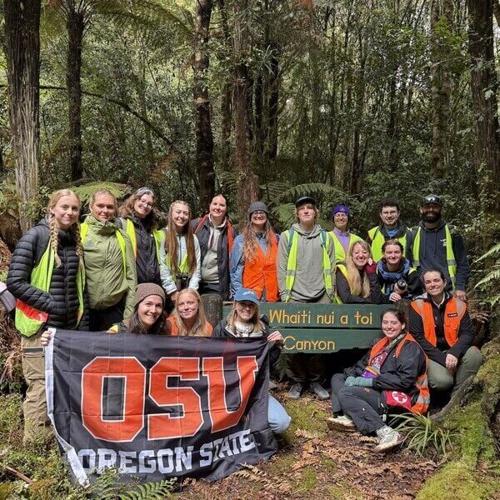
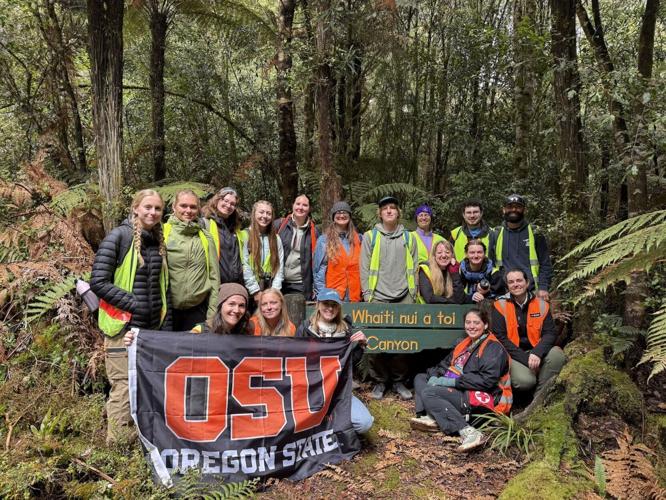
Norah Steed, a senior in forest management who works in the International Programs Office, spent a term in Chile in 2025 on a program led by Guevara and College of Agricultural Sciences professors Ivan Arismendi and Kelly Biedenweg. She took classes alongside Chilean students and learned a lot outside the classroom through conversations with Indigenous U.S. students and their Chilean counterparts.
“I see TEK as another way to approach land management from a very fundamental, land-ethic level: ‘Here is the land. What is our relationship to it? What can we learn from it? What can we give back?’ There are more questions to ask than ‘How can we use it?’” Steed said. “Being able to operate from different land ethics and see that contrast lets you understand that one mindset is not the default or necessary way. I’m making decisions that exist within a framework of other options.”
Steed will co-moderate the panel with a recent graduate, Eliza Porter, who was also part of the 2025 Chile cohort. She invites anyone who is interested in Indigenous rights across the globe, along with anyone who wants to learn about different perspectives on land management and ecological restoration.
“Whether you’re interested in ecology or forestry or Indigenous studies, if you’re interested in international perspectives at all, or different cultural objectives, this will be great for that,” she said.